
Finding Fairfax Resident Records
Fairfax does not maintain one public list of everyone at an address. A property record can identify an owner, while a recorded deed names title parties. A directory entry ties a person to a place in a particular year. Court indexes, business filings, and licenses answer still different questions. None of those sources alone proves that a person currently occupies a home. Start with the name or address already known, preserve the spelling returned by the index, and seek a second record that matches the place and period.
For a current address, first determine whether it sits in the City of Fairfax or Fairfax County. Then use the appropriate assessment record. For a historic household, begin at the Virginia Room or Historic Records Center, where printed directories, maps, deed books, and finding aids supply older forms of an address. The Fairfax street directory follows the current address trail in more depth, while a one-name question belongs on the resident lookup route.
- Check the correct city or county parcel record by street address, owner name, or parcel identifier.
- Use the owner or legal description as a lead in the Circuit Court land-record index.
- Compare a recent court, voter, or public agency result only where its access rules permit the search.
- For an earlier household, look for the same name and address in the library's directories, maps, newspapers, and microform.
- When an online index ends, ask the custodian, courthouse research room, library, or archives for the documented next channel.
Fairfax City and County Lines
The City of Fairfax is an independent Virginia city and the Fairfax County seat. That history makes it easy to mistake a city address for a county address. The city has its own WebPro assessment database and separate permit portal. Fairfax County operates iCare, MAR, Jade, My Neighborhood, county assessment records, and county court services. County MAR expressly excludes City of Fairfax addresses. A 22030 mailing address alone does not settle the question.
Use the property result, parcel identifier, and official boundary context before choosing a clerk, assessor, or election office. The City of Fairfax describes its independent-city status in its official city profile. This jurisdiction check matters most when a search moves from a postal address to a deed, permit, or local case file.
Fairfax Resident Records Offices
Three offices provide the starting points most often used for Fairfax resident research. The assessment systems connect addresses and parcels to displayed ownership or mailing information. The Circuit Court keeps land records and many historic series. Virginia's election system offers a personal voter-status tool, while public voter-list access remains limited by state law. These offices hold different record types, so a matching name should be checked against the record's date and purpose.
Fairfax Circuit Court Clerk
Land Records Division and Historic Records Center
Fairfax, Virginia
County Assessment Office
Fairfax County Department of Tax Administration
County parcels, owners, sales, and assessments
iCare assessment search
Virginia Elections
Statewide personal voter-status channel
Locality and identity fields are required
Citizen Portal
City parcels belong in the City WebPro system, not the county assessor result. The court's Research Room and Historic Records Center are the fallbacks for material that a free web index does not show.
Fairfax Parcel Search Details
County iCare is the most useful first stop for a Fairfax County address. It offers address, map-number, and map search paths, and its displayed information can include ownership, sales, assessed value, and physical characteristics. The property location form accepts number, unit, street, and suffix fields, gives wildcard instructions, and offers result sorting. The City of Fairfax uses WebPro, which displays its own parcel, owner or address, legal description, sales, assessment, use, size, and book-page fields.
| Search field | How it helps |
|---|---|
| Address | Finds a property location; the exact suffix and unit help narrow a match. |
| Map number or PARID | Connects an assessment result to a parcel or tax-map reference. |
| Owner name | Finds displayed ownership, not a guarantee of occupancy. |
| Legal description | Supplies wording that can be compared against a recorded deed. |
The iCare property-location form shows the address inputs and sorting controls used for county parcels.
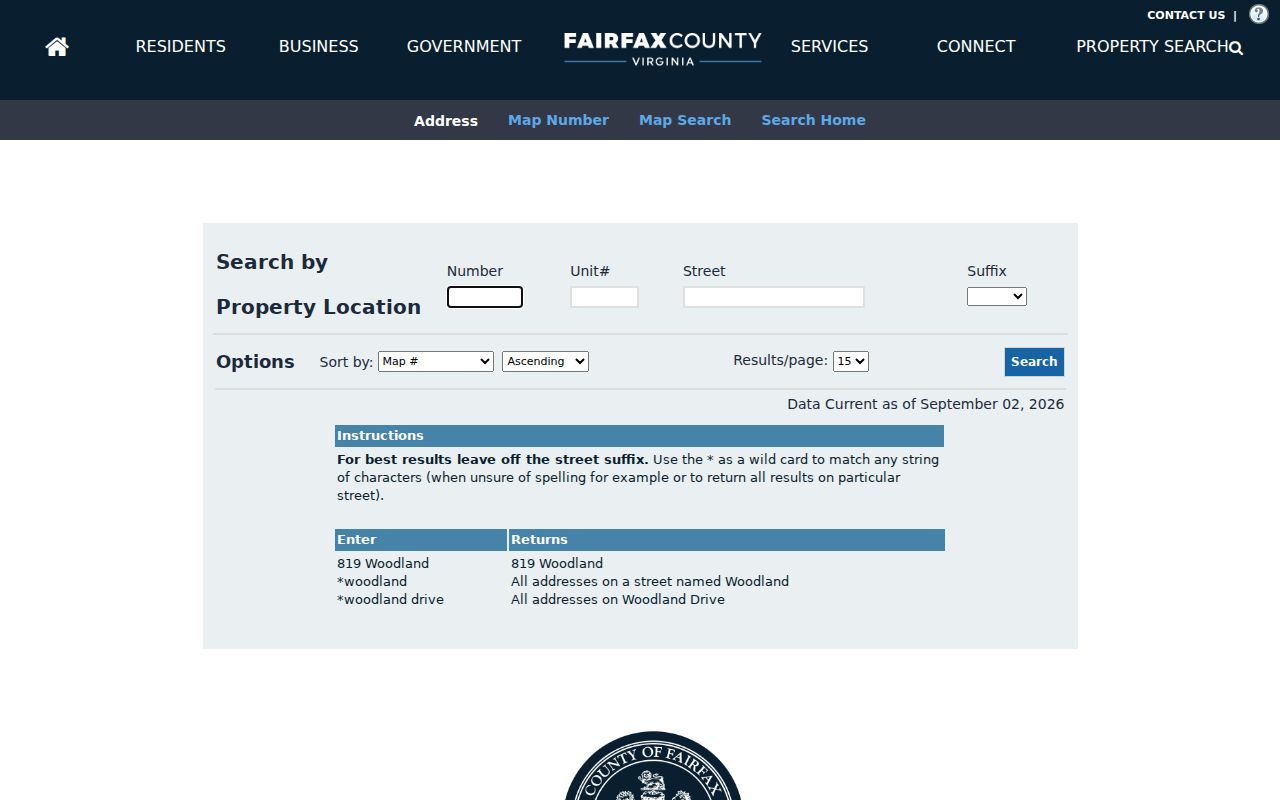
Use the returned address as a record lead, then compare its parcel information with the deed index before drawing a conclusion about title.
The City of Fairfax WebPro parcel database is the corresponding city-side source.
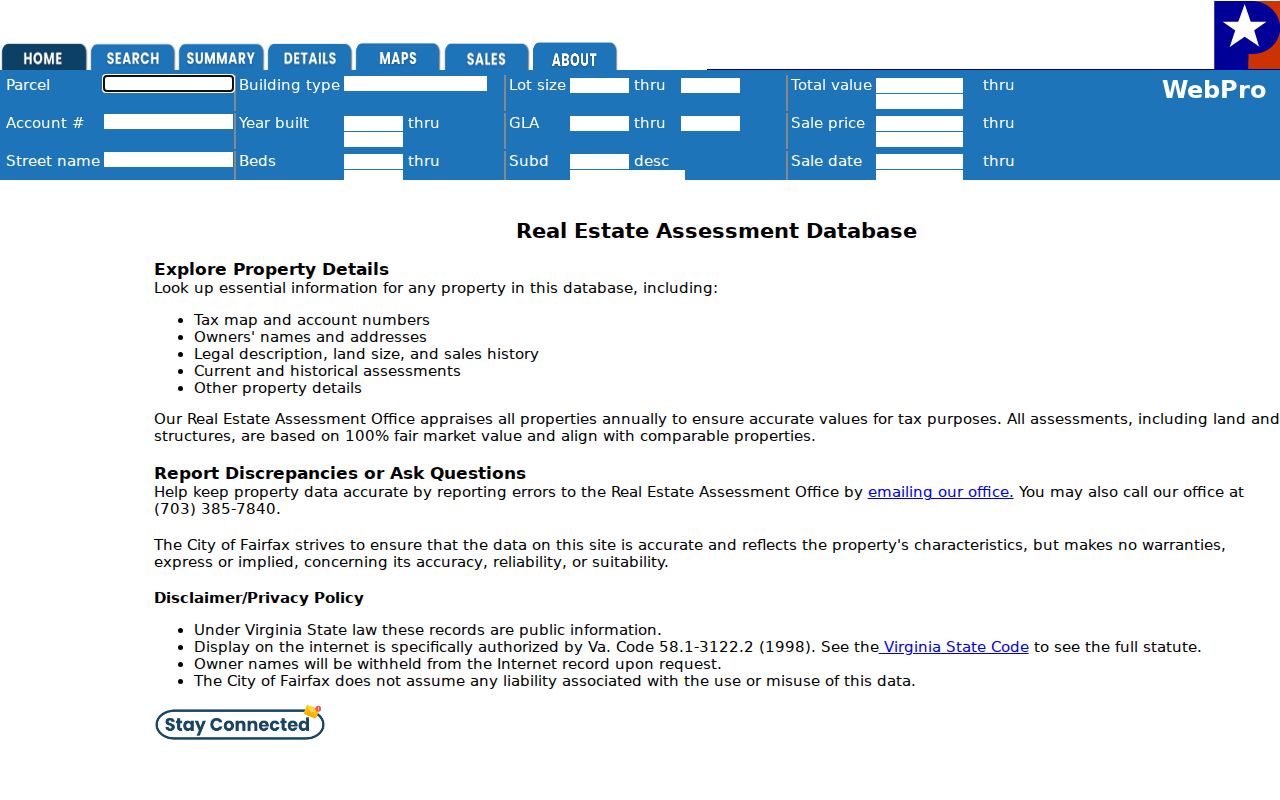
WebPro's city-focused fields help keep a Fairfax City result separate from the surrounding county's assessment roll.
Fairfax Court and Land Indexes
A parcel card is not a title record. The next step is the Fairfax Circuit Court land-record trail, which reaches from 1742 to the present but is split between current access, historic books, and subscription service. The Historic Records Center keeps original land records through 1942 and deed books before 1945. Grantor and grantee indexes for 1866 through 1946 can be reached at HRC or through CPAN. A grantor transfers an interest; a grantee receives it. Those terms are useful when moving backward through a deed chain.
For a name in a circuit case, the free eCaseSearch tool requires Civil or Criminal and a Party Name or Case Number selection. It indexes cases from October 18, 2004, limits a search to 100 results, and does not publish documents or sealed cases. The case number opens a detail view, but an index match is not an official file or proof of an allegation.
The Court Public Access Network explains the subscriber route for older circuit materials and land, probate, marriage, business, notary, and assessment records.
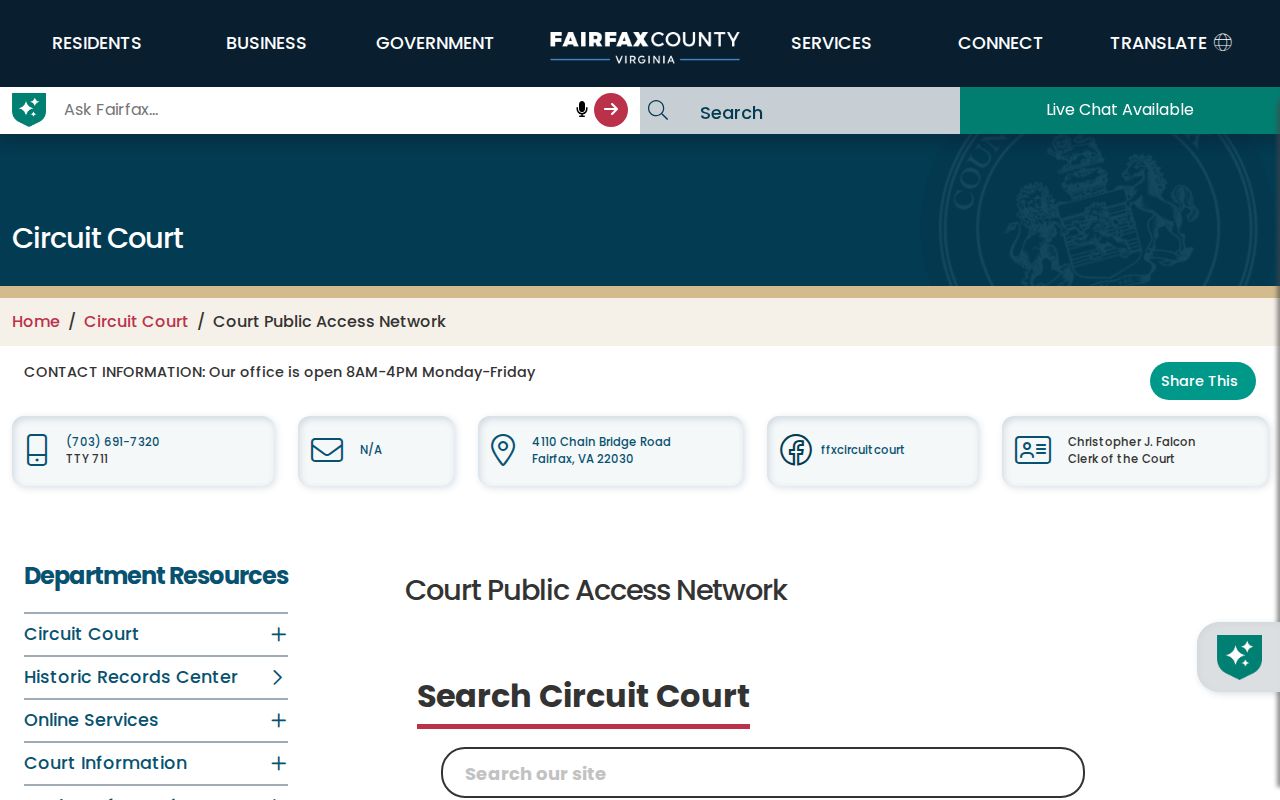
CPAN complements, rather than replaces, the courthouse Research Room and the Historic Records Center.
The free Fairfax eCaseSearch portal shows the civil and criminal search choices used for the current circuit index.
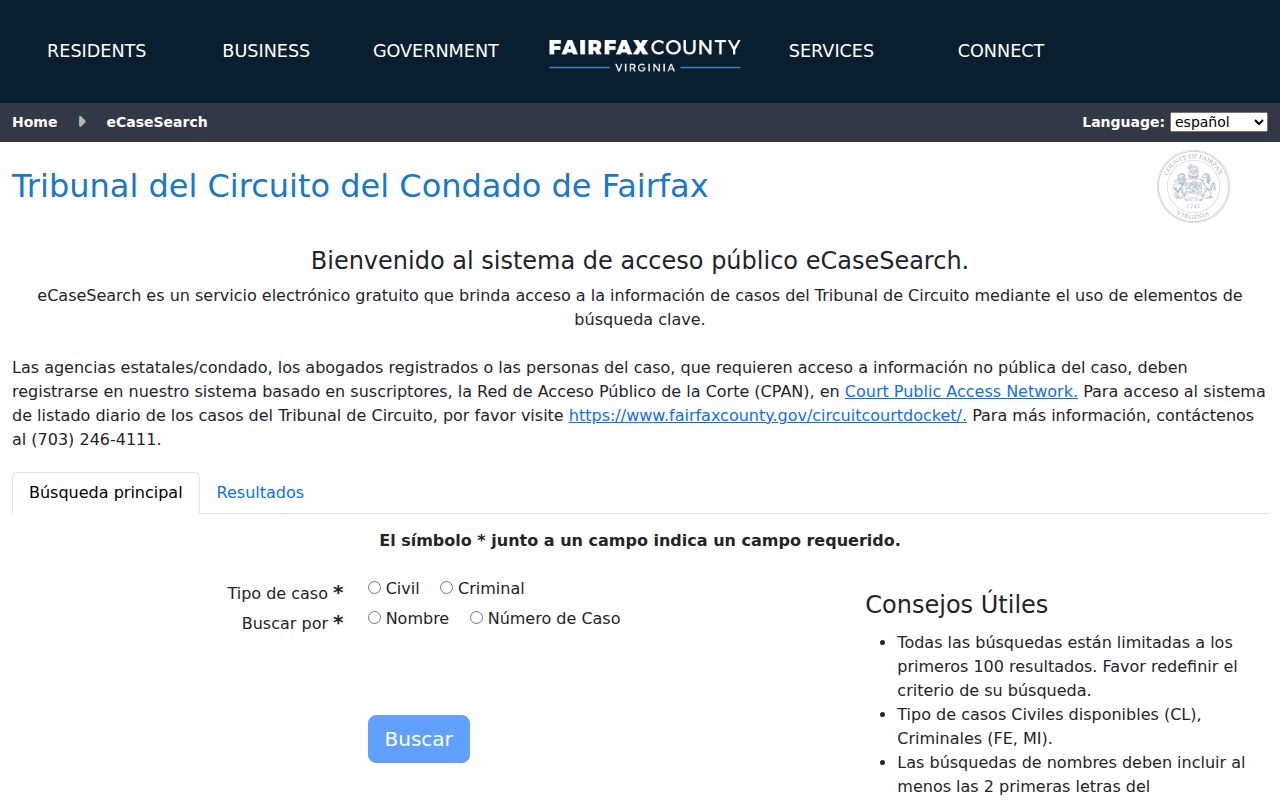
When a result needs a document, file-review request, public terminal, or clerk contact is the documented next step.
Current Fairfax Resident Directories
Current Fairfax directory-style sources are role-specific. A property roll identifies displayed owners and property facts. A deed index identifies recorded parties. A voter source is tightly controlled and is not an open name directory. Court, license, and business systems can confirm a particular record relationship, but none should be treated as a complete current-household list. Keep owner, title party, registered voter, license holder, and occupant as separate labels.
| Fairfax source | What it can confirm | Custodian | Access path |
|---|---|---|---|
| County iCare or City WebPro | Parcel, displayed owner, sales, assessment facts | County DTA or City assessment office | Public web search |
| Circuit land records | Recorded title parties and instrument references | Fairfax Circuit Court Clerk | Research Room, HRC, or CPAN |
| Citizen Portal | A user's voter status and polling information | Virginia Department of Elections | Personal authenticated lookup |
| eCaseSearch | Public civil or criminal case-index entry | Fairfax Circuit Court | Free index with limits |
For a person-specific workflow, the Fairfax resident lookup explains how to test a name across distinct official sources without confusing one record role for another.
Fairfax Voter Record Boundaries
Virginia's Citizen Portal is designed for a person to view voter registration, status, polling, election district, and voting-history information. It asks for name, date of birth, the last four digits of a Social Security number, locality, and a certification. Do not share or reproduce those authentication details. Virginia Code provisions restrict VERIS and voter-list access. Public locality lists have limited fields and omit Social Security numbers, day and month of birth, protected-address substitutions, registration-agency information, and declination data.
The Virginia Citizen Portal entry is the official start for personal voter information.
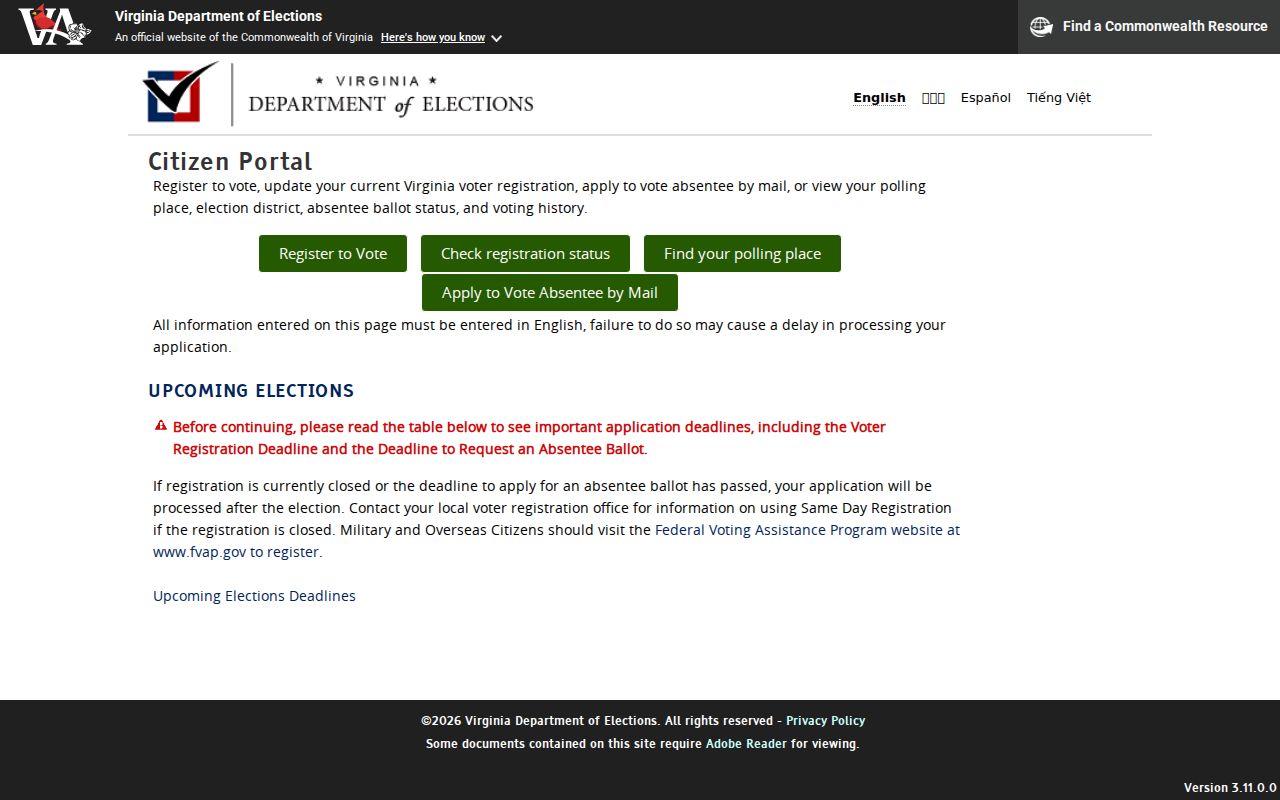
Use a voter result only for the specific, permitted status question and never as a substitute for a current-residence finding.
Note: Voter records have statutory access limits, and a missing or protected result does not establish that a person has no Fairfax connection.
Fairfax Vital and Archive Trails
Virginia Department of Health vital records provide a carefully limited route for births, deaths, marriages, and divorces. Under Virginia Code §32.1-271, birth records become public after 100 years. Death, marriage, divorce, and annulment records open after 25 years, subject to stated exceptions. Before those periods, certified copies generally require an immediate-family or other qualifying requester with identification. The current VDH fee is $15 per certificate or search, effective July 1, 2026. Processing statements vary among current VDH pages, so retain the form and fee page used on the request date.
Older Fairfax work often moves to the Virginia Room, the Historic Records Center, and the Library of Virginia. The Virginia Room has directories, newspapers, maps, yearbooks, manuscripts, microform equipment, and a CPAN workstation. Surviving statewide birth and death records exist for 1853 through 1896, but Virginia had no birth and death registration law from 1896 until June 14, 1912. That gap calls for newspapers, probate, cemetery, church, or property sources rather than a blanket negative conclusion.
- Index
- A finding tool that points to a record but may not provide the original or a certified copy.
- Certified copy
- A custodian-issued copy with legal certification, subject to access rules and fees.
- Criss-cross directory
- An address-arranged directory that can help link a household to an older street location.
Historical Fairfax Resident Directories
Historical directories are dated snapshots of a Fairfax household, not live residence proof. The Virginia Room holds city directories, telephone books, maps, newspapers, yearbooks, and local-history guides. William & Mary's Gale database makes Virginia city and business directories for 1801 through 1929 available as a separate research channel. The Library of Congress also describes city and telephone directory access on microfilm for many places and years, with gaps in coverage.
A printed name, occupation, spouse notation, street address, or owner-renter marker can become a useful lead when paired with a deed book, census, newspaper, or map. The Fairfax city directory page focuses on reading those volumes and tracing a household across years. The 1879 G. M. Hopkins atlas and preserved land-tax books add another dated layer for property history.
Fairfax Custody Search Limits
Sensitive public-safety sources answer narrow questions and have different coverage. Fairfax County's Adult Detention Center provides an information channel but the captured county material did not expose a public name-search roster. Virginia Department of Corrections NAAVI searches state-supervised people by name, county, or DOC ID and permits an asterisk wildcard. The Virginia State Police registry offers public search by name, address, ZIP, city, county, registry number, or radius. Neither statewide source is a complete local custody history.
The Virginia State Police registry presents its public search and use notice.
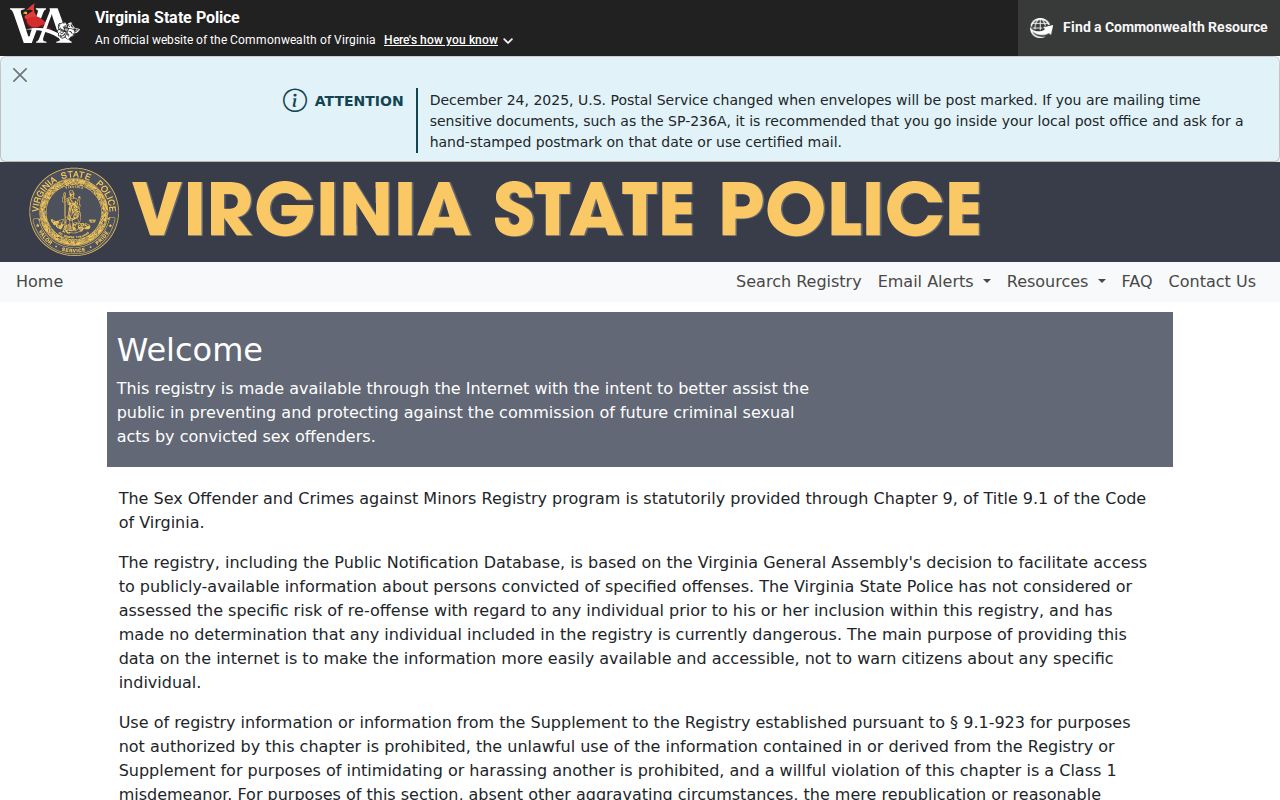
Registry information should be read with its own warnings and should never be used to harass, threaten, or profile a person.
The Virginia DOC NAAVI search offers its separate name, county, and DOC-ID route.

NAAVI identifies a state-supervision search path, not a comprehensive record of every Fairfax detention or court matter.
Fairfax Privacy and Requests
Virginia Freedom of Information Act, Va. Code §§2.2-3700 through 2.2-3715, gives a request route for records held by a public body, but it does not override record-specific confidentiality rules. Under §2.2-3704, a request should identify records with reasonable specificity. A public body normally responds within five working days by producing, denying, partly producing, stating that records cannot be found, or using a permitted extension. Reasonable actual costs may apply, and a deposit may be required when estimated charges exceed $200.
Send a Fairfax request through the county FOIA process or to the City or County custodian that actually holds the record. Virginia's Address Confidentiality Program protects eligible participants through a substitute mailing address, and DMV, vital, juvenile, sealed, expunged, and some voter information have separate limits. A corrected source or a refusal to release a record is often the appropriate result.
Note: Preserve the portal date, search fields, jurisdiction, and result limit with any research note because Fairfax systems and access rules can change.
Fairfax Records Need Dates
Fairfax's strongest local records feature is depth. Circuit Court and HRC materials reach to the county's 1742 founding, while the 1879 atlas and land-tax books from 1892, 1900, and 1910 received a preservation grant announced in June 2025. Yet the archive history also notes incomplete Civil War-era material and lost records connected with the 1875 clerk-building fire. A search plan should name the book series, date span, spelling, jurisdiction, and whether the result was an index, image, original, or certified copy.
That practice helps with property-fraud checks as well. Compare unexpected deed or tax messages directly against the official city or county property portal, then contact the clerk or police using a published channel. A record result is most useful when it can be traced back to its custodian and date.
Fairfax County's December 2025 guidance directs readers toward official assessment checks and published reporting channels when a suspicious property notice appears. It does not substitute an unverified message for a parcel or instrument search. For a city parcel, use City WebPro; for a county parcel, use iCare; then compare the legal description, displayed owner, and recorded document reference. A mismatch can be a reason to ask the Circuit Court Clerk which record is authoritative. Keep the retrieval date with each screen or book reference, since assessment, directory, court, and election systems update on different schedules.