
Fairfax City Directory Runs
The strongest local starting point is the Virginia Room at City of Fairfax Regional Library. Its local-history holdings include directories, telephone books, newspapers, maps, yearbooks, manuscripts, and property-research guides. Fairfax has identifiable dated directory leads, but the research did not find an authoritative shelf-by-shelf inventory for every City and County volume. Treat the listed years as request leads, then ask for the particular location and year rather than assuming a run is complete.
| Collection | Years | Where Held | Access |
|---|---|---|---|
| Virginia city and business directories | 1801–1929 | William & Mary database | Online database landing page |
| Hill’s City Directory leads | 1963, 1967, 1971 | Virginia Room or another library service | Request the actual volume |
| Haines Criss-Cross Directory leads | 1977, 1982, 1987 | Virginia Room or another library service | Address-oriented dated lead |
| United States city-directory microfilm guide | Generally 1861–1960 | Library of Congress | Request by location and year |
The Hill’s and Haines dates come from a Fairfax County procurement attachment that reproduced a historical-directory research table. Several sample street rows were not listed, so they demonstrate a method and source title, not continuous coverage. The Library of Congress likewise cautions that directory runs have gaps. A missing name can reflect the edition, the geographic scope, an abbreviation, or the head-of-household convention.
Fairfax City Directory Shelves
The Virginia Room is on the second floor of City of Fairfax Regional Library at 10360 North Street. It provides local-history and genealogy material, a microform reader with USB output, computers, a CPAN workstation, and Memory Depot equipment. Captured building hours are Monday through Wednesday, 10:00 a.m. to 9:00 p.m., and Thursday through Sunday, 10:00 a.m. to 6:00 p.m. Room service can differ, so confirm before a special trip at 703-293-6227, option 6.
The Virginia Room collection page is the source for its directory, newspaper, map, and microform access. Bring a name variant, a target street, a date range, and the jurisdiction written on the old record. That preparation helps staff locate the right shelf or reel and keeps a Fairfax City question from being sent to an unrelated County collection.
The Virginia Room collection page identifies the local-history resources available for a Fairfax city directory search.
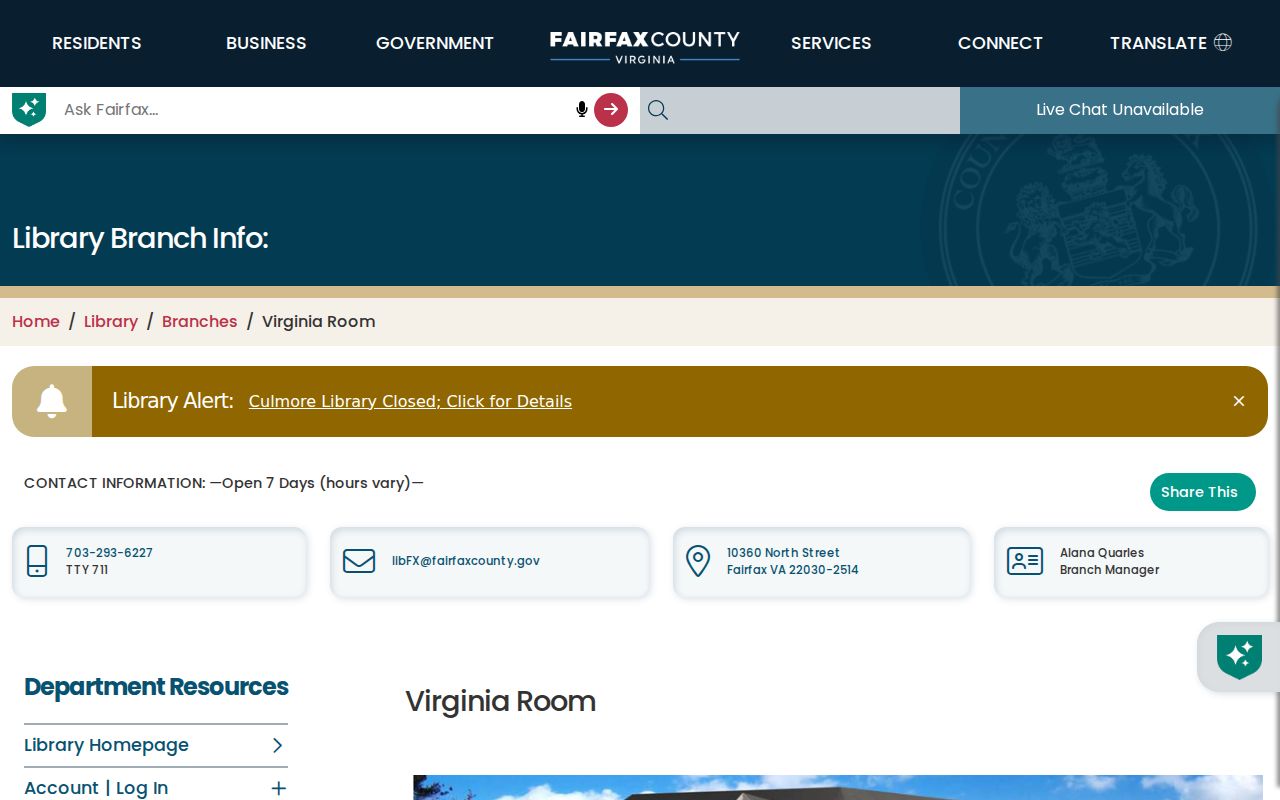
The collection page supports an in-person fallback when a digitized result or a general web search does not reveal the edition needed.
Fairfax City Directory Online Leads
Online leads narrow a request, but they do not replace the volume. The William & Mary Virginia directories database identifies a Virginia directory resource covering 1801 through 1929. For local manuscript and archival context, the ARVAS Virginia Room repository offers finding aids whose descriptions identify collection, creator, date, extent, and repository. A finding aid is not automatically a digitized page or permission to reproduce one.
William & Mary’s database landing page is an online entry point for Virginia city and business directories.
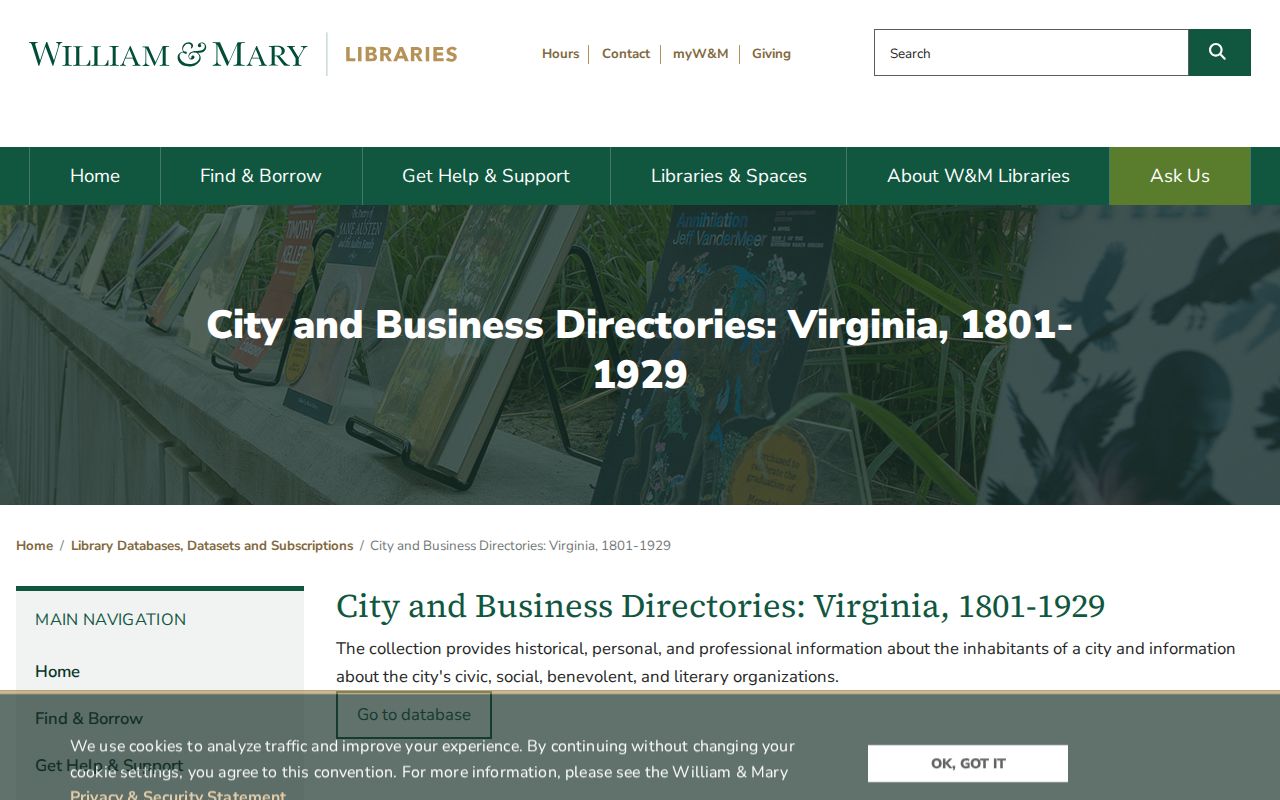
Use its date range to formulate a library request, then record the edition and page when a Fairfax listing is located.
The ARVAS repository search supplies descriptions of regional archival material that can add Fairfax context to a directory lead.
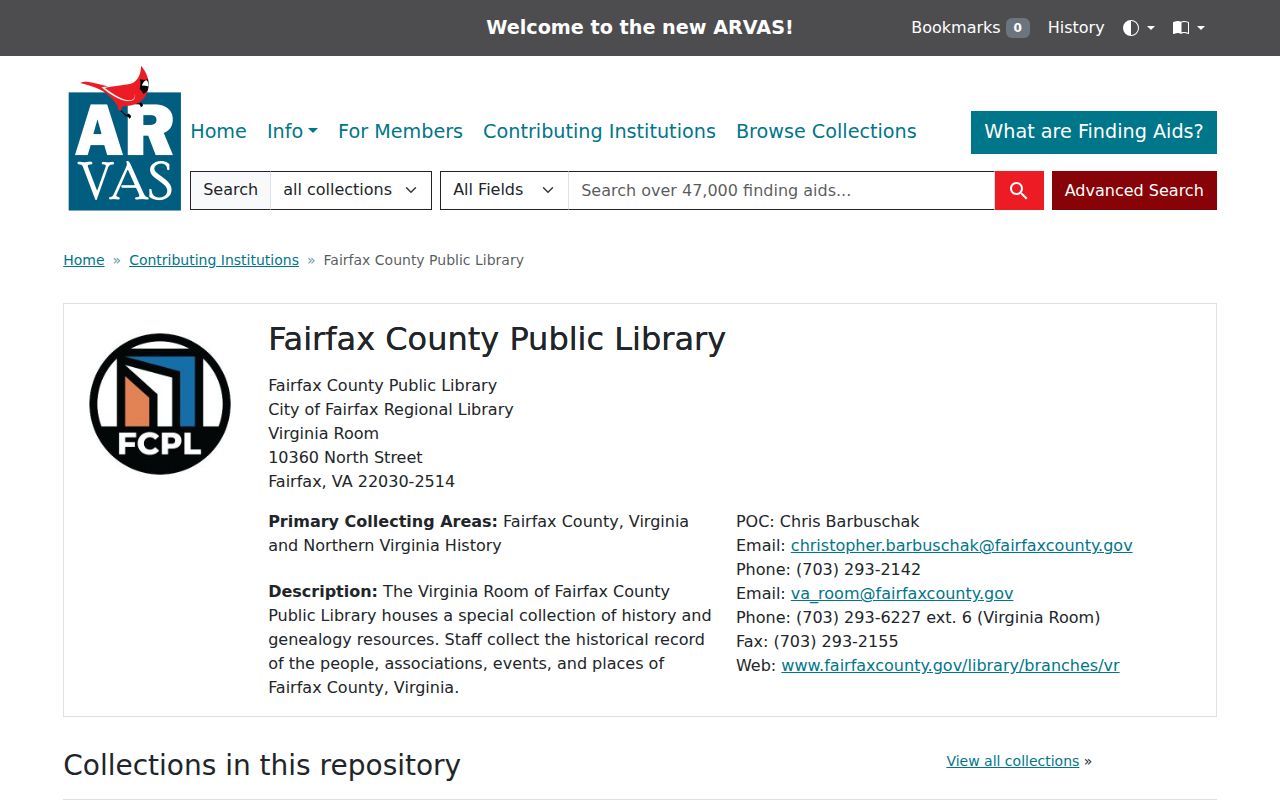
Repository metadata is useful for choosing a collection, while the Virginia Room or the named repository remains the access point for the underlying material.
Reading Fairfax City Directory Entries
No digitized Fairfax entry page in the captured research showed an occupant, spouse notation, owner mark, or abbreviation key. For that reason, do not fill those fields from memory or assume they appear in every edition. A careful directory note preserves the edition year, directory title, page, name exactly as printed, address, nearby cross-reference, and whether the listing is residential, professional, or institutional. That makes the entry useful even when the volume uses a different layout.
| Name as printed | Keep initials, spelling, and any suffix exactly as the volume gives them. |
|---|---|
| Edition and page | Record the title, year, and page or a clear “not listed” result. |
| Address context | Preserve the number, street spelling, suffix, and nearby cross-reference. |
| Listing kind | Mark whether the entry appears residential, professional, or institutional. |
| Source trail | Note the shelf, reel, database, or finding aid used to retrieve it. |
- Criss-cross directory
- An address-first directory that works from a street and number toward a dated occupant or subscriber lead.
- Householder index
- An alphabetical arrangement that may identify one household representative rather than every person at the address.
- Abbreviation key
- The volume’s own explanation of shortened labels; photograph or transcribe it before interpreting a mark.
Names can be abbreviated, misspelled, omitted, or filed under a larger nearby community heading. A directory entry is evidence of a dated association, not proof of continuous residence, family relationship, or legal ownership.
Fairfax City Directory Address Years
For an old address, the Haines Criss-Cross leads from 1977, 1982, and 1987 are especially useful because a criss-cross volume begins with the street. The official attachment that names those sources also identifies Hill’s city directories for 1963, 1967, and 1971. It records the target street, directory year, source title, page when reported, and whether a street or target was listed. That is a sound audit trail for a research note.
Start with the address exactly as it appears in the deed or family record. Test former street names, suffixes, adjacent roads, and nearby landmarks only after preserving the original form. A road may be absent because it was new, its volume served a different geography, or the address was filed under a nearby community. For a current parcel or owner display, use the modern address-record route on the Fairfax street directory rather than treating a dated directory as a current list.
Note: A “not listed” row identifies the volume and year searched, but it does not establish that a person or address never existed.
Trace Fairfax City Directory Households
A sequence of Fairfax city directories can help build a household timeline between other dated records. Begin by locating the earliest printed version of the surname or street. Copy the entry without normalizing it. Move forward through the available editions and record each address change, spelling change, page reference, and gap. Then compare the address-oriented lead with deeds, maps, newspapers, yearbooks, or probate material that matches the same period.
- Choose a Fairfax edition year and search the name exactly as printed in the family material.
- Record the title, page, address, and listing kind, including a clear not-listed result.
- Check the next available edition, not an assumed annual sequence, and compare the original spellings.
- Use a Haines address lead when the house is known, then corroborate it with a deed, permit, map, or newspaper date.
- Keep City of Fairfax and Fairfax County results in separate columns until the jurisdiction is confirmed.
School yearbooks and historical newspapers can provide companions to a Fairfax city directory result. The Virginia Room holds nearly 500 physical FCPS and private-school yearbooks and participated in digitizing more than 300 yearbooks from 36 schools. Those materials can place a name in a dated school or community context, but they are not a substitute for a directory entry.
Fairfax City Directory Jurisdictions
Fairfax research has a jurisdiction problem before it has a name problem. The City of Fairfax began as the Town of Providence in 1805 and became independent in 1961. It has its own clerk, assessment, cemetery, and permit systems, while Fairfax County surrounds the City and holds much of the historic county record environment. A printed “Fairfax” result should be checked for City or County context before it is attached to a household or parcel.
The Circuit Court Historic Records Center describes land, probate, court-order, and chancery material from 1742 into the 1940s. Early series have gaps, and the clerk’s building burned in 1875 after records were also lost or carried away during the Civil War era. An absent directory or index entry can therefore reflect a damaged series, a transfer boundary, or a collection gap rather than a definitive negative finding.
| 1799 | The courthouse moved to Providence. |
|---|---|
| 1805 | Providence was founded as a town. |
| 1875 | The clerk’s building burned. |
| 1961 | The City of Fairfax became independent. |
| 2013 | Historic records returned to the courthouse complex. |
Fairfax City Directory Map Partners
A directory address becomes more useful when paired with a dated map or tax record. Fairfax research guidance recommends comparing the 1879 G. M. Hopkins atlas, Sanborn maps, historic map books, the county inventory, and the Virginia Historical Inventory with the deed chain. Sanborn holdings generally begin around 1885 and continue into the 1960s at the Library of Congress, Library of Virginia, and UVA. A building outline or an owner label is a lead, not proof that a current structure or household was present.
In June 2025, Fairfax Circuit Court reported preservation support for the 1879 atlas and Land Tax Books from 1892, 1900, and 1910. Tax-book and atlas labels can connect a name, parcel, and period, but the recorded deed remains the way to verify a legal transfer. Record the map title, year, sheet or page, exact label, and adjacent landmarks before searching the name in an archival index.
Fairfax City Directory Place Clues
Neighborhood and locality labels help find the right heading, not a person’s social ties. Preserve wording such as City of Fairfax, Fairfax County, Providence, Old Town, Annandale, Vienna-adjacent, Merrifield-adjacent, and a named subdivision exactly as returned. The City’s small footprint makes municipal boundaries especially important, while the surrounding County’s larger ZIP and subdivision geography can place the same postal label under a different custodian.
The Virginia Room’s photographs, oral histories, subject files, newspapers, and manuscripts can add place context that a city directory alone does not show. Use them to select a better map sheet, directory heading, or archival collection. Do not infer that a named person belonged to a group, attended an event, or used a service without a direct record.